 Belly Care
A poop tracker turns something you do every day into genuinely useful data about your gut. Instead of vague memories like "I've been a bit off this week," you get a real picture of what's happening, when, and what might be driving it.
Most people are surprised by what a single week of logging reveals. Patterns that felt random, like bloating after certain meals or looser stools on stressful days, start to look a lot less random once you can actually see them laid out.
What a poop tracker actually does
Your gut sends signals every day, but without a record they are easy to dismiss or forget. A digestive health log catches those signals before they slip away, turning a fuzzy sense of "something's not right" into concrete, dateable entries you can work with.
The real power is not any single log entry. It is the pattern that builds over days and weeks, showing you connections between what you eat, how you sleep, how stressed you are, and how your gut responds.
The Bristol scale: your gut's common language
The Bristol Stool Scale is a simple 1-7 visual guide that doctors use to describe stool consistency. Type 1 looks like separate hard lumps; type 7 is entirely liquid. Types 3 and 4 sit in the middle and are generally considered the healthy range.
It sounds clinical, but it is actually very practical. Instead of writing a paragraph describing what you saw, you just pick a number. That makes tracking fast, consistent, and easy to review later. Research backs the scale as a reliable proxy for gut transit time, which is why gastroenterologists use it routinely.
Consistency beats perfection
You do not need to log every detail every day. Missing the odd entry will not ruin your data. What matters is showing up regularly enough that patterns have a chance to emerge.
Even a week of honest, simple logging can be eye-opening. One self-tracker who logged daily for 31 days found he could identify his personal baseline and spot deviations he would never have noticed otherwise, as this detailed personal tracking experiment shows.
Reading the Bristol scale: what your body is telling you
Walking through the scale in plain terms makes tracking much more useful, because knowing what you are looking at changes how you respond to it.
Types 1-2: slow transit
Types 1 and 2 are hard, lumpy, and difficult to pass. They are associated with slow gut transit, meaning food is moving through your colon more slowly than ideal and water is being absorbed out of the stool over time. This is what constipation tracking is really looking for.
If you regularly see types 1 or 2, it is worth noting what else is going on that day: how much water you drank, how much fiber you ate, and how active you were.
Types 3-4: the range to aim for
Type 3 is sausage-shaped with some cracks on the surface. Type 4 is smooth and soft. These are the types most people and clinicians consider normal and comfortable.
If your tracker shows you are mostly hitting 3s and 4s, that is a genuinely good sign. Your job then is to notice what is different on the days you do not.
Types 5-7: faster transit
Types 5, 6, and 7 get progressively softer and more urgent. Type 5 is soft blobs with clear edges; type 7 is entirely liquid with no solid pieces. These suggest your gut is moving things through faster than usual, or that something is irritating the lining.
An occasional type 6 after a rich meal or a stressful day is usually nothing to worry about. But if you regularly see types 6 or 7, that is a pattern worth paying attention to and worth mentioning to a doctor if it persists.
Type alone is not the whole story
Frequency and timing matter just as much as consistency. Most healthy adults have between three bowel movements a week and three a day, so there is a wide range of normal. What matters most is whether your pattern is stable and comfortable for you.
Tracking all three things together, type, frequency, and timing, gives you a much richer picture than any one of them alone.
How to start tracking without overthinking it
The biggest mistake people make is trying to log too much and burning out by day three. Keep it simple, especially at the start.
Log once a day at the same time
Pick a moment that is easy to remember, maybe just before bed or after your morning coffee. A quick 60-second entry is all you need. The habit matters more than the detail.
Note the Bristol type and one or two symptoms
Pick your Bristol number, then add any symptoms you noticed that day: bloating, cramping, urgency, or nothing at all. That is genuinely enough to start building useful data.
Add what you ate
You do not need a full food diary. Just note the main meals and anything unusual, a new restaurant, a high-fiber day, alcohol, or a lot of processed food. Belly Care makes this quick by letting you log meals and symptoms in the same place, so you can start spotting food triggers without juggling separate apps or notebooks.
What patterns to look for by day 7
After a week, scroll back through your entries. You are not looking for a diagnosis. You are looking for patterns to explore.
The food-to-symptom time lag
This is the one that surprises people most. Your gut transit time means a meal you ate on Monday might not show up as a change in your stool until Tuesday or Wednesday. Transit time typically ranges from 12 to 48 hours, so look back a day or two before any notable change, not just at what you ate that morning.
Fiber and consistency
Do your type 3-4 days tend to follow higher-fiber meals? Or do certain high-fiber foods actually make things worse for you? Both patterns are real and worth knowing. Some people find that a sudden increase in fiber causes bloating and loose stools before things settle down.
Stress and sleep
The gut-brain connection is well established. Your colon follows a circadian rhythm, and disrupted sleep or high-stress days often show up in your gut the next morning. If you note your stress level or sleep quality alongside your gut log, the correlation can be striking.
IBS patterns
One of the most common things people notice when tracking IBS patterns is alternating between constipation and loose stools, sometimes within the same week. Seeing that written down, rather than just feeling it, makes it much easier to discuss with a doctor or dietitian.
Common patterns and what they might suggest
Here are a few patterns that come up often in gut health tracking and what they might point to. These are patterns to explore, not diagnoses.
- Alternating between types 1-2 and types 6-7: This back-and-forth is one of the hallmark patterns some people with IBS describe. It is worth tracking carefully and sharing with your GP if it persists.
- Consistently loose stools after certain meals: This might point to a specific food trigger, a sensitivity to fat, lactose, gluten, or certain fermentable carbohydrates. Belly Care's food trigger tracking is designed specifically to help you spot these links over time.
- Improvement after adding fiber: If your consistency moves toward types 3-4 when you eat more vegetables, legumes, or wholegrains, your gut may simply have been under-fed in terms of prebiotic fiber.
- No change despite two or more weeks of tracking: If nothing seems to correlate and symptoms persist, that is genuinely useful information to take to a healthcare provider. Your log becomes evidence, not just a feeling.
If you notice red-flag symptoms at any point, including blood in your stool, unexplained weight loss, or severe pain, please see a doctor promptly rather than waiting to see if a pattern emerges.
Choosing a poop tracker app
If a notebook feels like too much friction, a dedicated app can make logging almost effortless. Several well-reviewed poop tracker apps are available for both iOS and Android, each with slightly different features depending on what you want to monitor.
Plop and Poop Log are popular options that let you record Bristol type, frequency, and notes in a few taps. For people managing IBD, bowel movement tracking is already embedded in condition management tools because objective data helps clinicians make better decisions. Whichever tool you choose, the most important thing is that it fits your routine so you actually use it.
How to use your data to make real changes
Tracking is only half the job. The other half is using what you find.
Change one thing at a time
If you try cutting dairy, adding more fiber, and reducing stress all in the same week, you will not know which change helped. Pick one variable, give it a week or two, and see what your tracker shows. It is slower, but the signal is much cleaner.
Track for another week after any change
One good day after a dietary change does not confirm anything. A week of improved consistency does. Give your gut time to respond before drawing conclusions, because transit time and microbiome shifts take days to show up in your stool.
Share your log with your doctor
This is one of the most useful things you can do. A week or two of logged Bristol types, symptoms, and meals is far more informative than trying to remember how you have been feeling. A structured log gives your clinician something concrete to work with, and it saves you from having to reconstruct your history from memory in a ten-minute appointment.
Belly Care lets you export your gut health log so you can bring it to appointments without having to scroll through your phone and explain everything from scratch.
Be patient with yourself
Gut patterns take time to emerge, and they take time to shift. A week of tracking gives you a starting point; a month gives you real confidence. The goal is not a perfect gut overnight. It is understanding your gut well enough to make small, informed changes that actually stick.
If symptoms persist despite your best efforts at tracking and adjusting, please speak to a GP or registered dietitian. A digestive health log is a brilliant tool to bring to that conversation, but it works best alongside professional guidance, not instead of it.

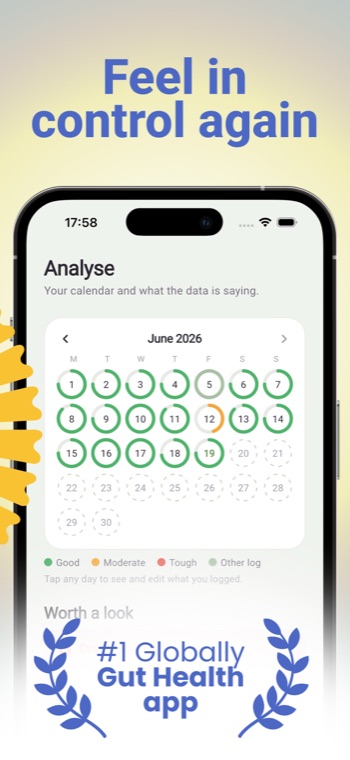
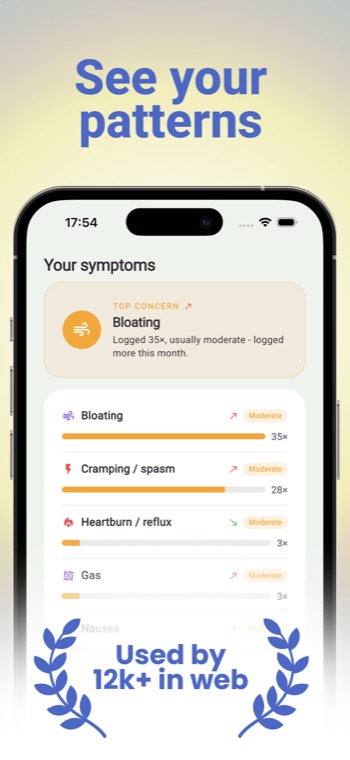
Find your own gut patterns
Belly Care turns a few honest minutes a day into a clear picture of what's linked to how you feel — bloating, IBS, energy and mood.
Download on the App StoreSources
Belly Care helps you observe patterns and build healthy habits — it doesn't diagnose or treat any condition. The patterns it surfaces are starting points to explore, not medical advice. For persistent symptoms, please see a doctor.
Frequently asked questions
How long does it take to see patterns in a poop tracker?
Most people start noticing patterns after 7 days of consistent logging, but two to four weeks gives you much more reliable data. Gut transit time means there is often a 12 to 48 hour lag between eating something and seeing a change in your stool, so a longer tracking window helps you connect the dots more accurately.
What should I do if my poop tracker shows no clear pattern?
No clear pattern after two or more weeks of honest tracking is itself useful information. It may mean your symptoms are driven by something harder to pin down, like stress, hormones, or an underlying condition. Bring your log to a GP or registered dietitian. The data you have collected will help them ask better questions and investigate more effectively.
Is it normal for poop consistency to change day to day?
Yes, day-to-day variation is completely normal. What you eat, how much you drink, your stress levels, and your sleep can all shift your Bristol type by a point or two. The concern is persistent changes, consistently landing at types 1-2 or 6-7 over many days, especially alongside other symptoms like pain or urgency.
Can a poop tracker help diagnose IBS or other conditions?
A poop tracker cannot diagnose anything. That is a job for a doctor. What it can do is help you build a detailed, objective record of your symptoms, stool types, and potential triggers over time. That record is genuinely valuable when you see a clinician, because IBS and similar conditions are often diagnosed partly through symptom history, and a log is far more reliable than memory alone.